
Brambling
Fringilla montifringilla Linnaeus, 1758
Құнақ


 1 / 3
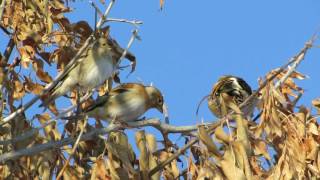
spring male Almaty, Republic Square
autumn male Almaty, Republic Square.
female Almaty, Samal
- status in Kazakhstan
- nests here · on migration · winters here
- conservation status
- IUCN LCleast concern
- sizes
- 13–18 cm, wingspan 23–30 cmweight 18–30 g
- when to see it
- March — Octoberwinters: November — February
- on the site
- 1104 observationslast: 4 Nov 2026
- videos
- 9
Description
С воробья. У самца в брачном наряде черные голова и спина, у части самцов, особенно в начале весны, черный цвет более или менее маскируется охристыми каемками; горло, зоб и грудь, а также плечевые оранжево-охристые. Самка окрашена снизу почти так же, как самец, но менее ярко, рыжий цвет не заходит на горло, голова светло-бурая, с темной бурой шапочкой и двумя продольными полосками на затылке, середина затылка светло-серая или буровато-белесая. Отличается от самки зяблика рыжей грудью, нет белых "эполет", вместо них - узкая рыжая или рыжевато-белая полоска, есть узкая рыжая полоска вдоль всего крыла. У самца и самки белая поясница, особенно хорошо видная в полете. Крайние рулевые полностью темные или есть немного белого у их основания. На боках есть темные пестрины. Полная линька в июле-сентябре. У самца в осеннем пере черный цвет на голове и спине большей частью закрыт охристо-рыжими каемками, которые обнашиваются к весне (у части самцов - не полностью). Окраска самки осенью меняется несущественно, становится больше рыжих тонов. Молодые в гнездовом наряде похожи на самку, но на животе и пояснице бурый или желтоватый налет. После летней линьки становятся похожими на взрослых. Вес 18-30 г, длина 13-18, крыло 8.2-9.9, размах 23-30 см.
Distribution
Breeding in Southwest Altai in vicinities of Ridder and on Markakol lake. On migration occurs everywhere. Wintering in southern half of Kazakhstan, in south from Furmanovo in Volga-Ural area, Kurgaldzhino Reserve and Semipalatinsk.
- I
- II
- III
- IV
- V
- VI
- VII
- VIII
- IX
- X
- XI
- XII
- Breeding
- Migration
- Wintering
Map © Birds.kz. Copying without permission is prohibited
Latest observations
all species photos · 1104 → 2


 2
Species videos · 9
all species videos · 9 →


Biology
Rare breeding migrant, but in non-breeding areas numerous passage migrant and common winter visitor. Inhabits the deciduous or mixed light forest (birch, willow, fir-tree) on marshes; on migration and wintering visits the various forests, shrub thickets, shelterbelts, gardens, fields and thickets of tall weeds. The spring movement in flocks of several dozen to several hundred birds begins in the end of February – early March; in southern areas migration finishes in mid-April, in northern ones in end of April – early May as soon as birds appear in breeding sites in Altai. Breeds in separate pairs. Nest is located on tree at height 4-5 m above the ground; nest is built from the dry grass and moss and is lined with the thin grass, feathers and hair. Clutch of 5-7 usually 6 eggs is laid in mid-May – early June. In autumn migration begins in third ten days of September – early October. The main flight paths pass on the Ural river valley and along the foothills of Tien Shan where the some compact flocks may contain up to 300-400 birds. Latest migrants recorded in November, later only wintering birds are observed.
Sources
Gavrilov E. I., Gavrilov A. E. "The Birds of Kazakhstan". Almaty, 2005. Э.И.Гаврилов. "Фауна и распространение птиц Казахстана". Алматы, 1999. В.К.Рябицев. "Птицы Урала, Приуралья и Западной Сибири". Екатеринбург. Издательство Уральского университета, 2000.