
White-tailed Sea-Eagle
Red Book of the Republic of Kazakhstan
Category II · declining species
Haliaeetus albicilla Linnaeus, 1758
Аққұйрық субүркіт


 1 / 3
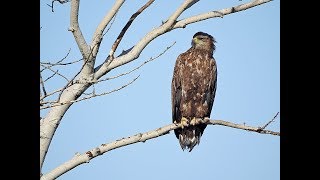
adult Sorbulak lakes system.
subadult Ust-Kamenogorsk, Pristan
juvenile Delta of Ile river, Southern Trans-Balkhash area
- status in Kazakhstan
- nests here · on migration · winters here
- conservation status
- Red Book of Kazakhstan · II IUCN LCleast concern
- sizes
- 70–98 cm, wingspan 200–250 cmweight 3–5.5 kg
- when to see it
- March — Novemberwinters: December — February
- on the site
- 1391 observationslast: 5 Nov 2026
- videos
- 3
Description
Крупнее беркута. Характерная особенность силуэта летящей птицы - длинные и широкие "прямоугольные" крылья, относительно маленькая голова, широкий короткий хвост клиновидной формы. У взрослых птиц хвост чисто белый. При парении держит крылья в одной плоскости, иногда - слегка приподнятыми и чуть согнутыми в кисти (тогда "прямоугольность" нарушается). Клюв массивный, желтого цвета. Голова, а нередко - вся передняя часть корпуса, гораздо светлее остального оперения, от светло-бурого до бледно-палевого. Существуют многочисленные индивидуальные вариации окраски в пределах описанной схемы. Как правило, чем старше птица, тем светлее. Глаза охристые. Молодые темно-бурые, со светлыми пестринами на туловище и крыльях. Хвост темный и несколько длиннее, чем у взрослых, менее клиновидный, можно разглядеть на рулевых более светлые центры. Клюв темный, глаза бурые. Подмышечные перья непременно очень светлые. Хвост с каждым годом становится все светлее, белое занимает все больше места, начиная от основания к вершине, полностью белым становится в 5-летнем возрасте. У некоторых птиц темные отметины на хвосте есть всю жизнь. У полувзрослых птиц окраска очень изменчива и все оперение выглядит как-то неряшливо из-за неправильно разбросанных пестрин. Вес самцов 3.0-5.5, самок - 4.0-6.9 кг, длина 70-98, крыло самцов 55.2-64.0, самок - 62.1-71.5, размах 200-250 см.
Distribution
Nests in Northern Trans-Caspian area, in Ural valley, in Naurzum, Pavlodar Trans-Irtysh area, on Markakol lake, in Zaysan and Balkhash-Alakol depressions, in valleys of Ile, Chu rivers and in lower reaches of Syrdarya. The recent years its number is increased. On migration and dispersal occurs everywhere. Winters on ice-free reservoirs of southern Kazakhstan (on Sorbulak lake in particular), and in Northern Trans-Caspian sea, sometimes on Barsa-Kelmes Island. On the channel Irtysh-Karaganda one bird was recorded 10 February 1982. Near 120 birds were observed on Chardara reservoir 18-21 December 2003.
- I
- II
- III
- IV
- V
- VI
- VII
- VIII
- IX
- X
- XI
- XII
- Breeding
- Migration
- Wintering
Map © Birds.kz. Copying without permission is prohibited
Subspecies
- White-tailed Sea-Eagle Haliaeetus albicilla albicilla
Latest observations
all species photos · 1391 → 3
 4

 6
Species videos · 3
all species videos · 3 →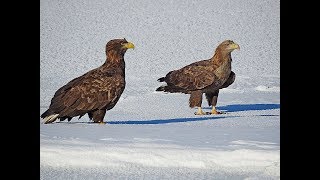

Biology
White-tailed Eagle is rare breeding migrant. Inhabits the riparian woods, the small woods of steppe zone near the fish-abundant lakes with reed thickets. Appears in the end of February or in March, latest birds flying in northern direction were observed in early April. Breeds in separate pairs at least 1-2 km apart. Nest is built in tree (asiatic poplar, russian olive, larch) at 3-12 m above the ground; nest is constructed from the thick twigs and is lined with dry grass, and often with fresh twigs with leaves. Each pair has 2-3 breeding nests which are rotated every year. Every year birds repaired the nest so the old nests become a quite large. Laying of 1-3 eggs is in March, both parents incubate but female mostly. Chicks hatch in April. Both parents feed nestlings which fledge in early June – July. Autumn migrations is in September – October, when the Sea-Eagles observed singly or in small groups in food abundant places (lakes with ducks and other birds).
Sources
Gavrilov E. I., Gavrilov A. E. "The Birds of Kazakhstan". Almaty, 2005. Э.И.Гаврилов. "Фауна и распространение птиц Казахстана". Алматы, 1999. В.К.Рябицев. "Птицы Урала, Приуралья и Западной Сибири". Екатеринбург. Изд-во Уральского университета, 2000.