Long-tailed Rosefinch
Uragus sibiricus Pallas, 1773
Кезқұйрық құралай

 1 / 2
male South Kazakhstan, Bugun'.
female VKO Katon-Karagay
- status in Kazakhstan
- nests here · on migration · winters here
- conservation status
- IUCN LCleast concern
- sizes
- 16–19 cm, wingspan 20–23 cmweight 14–20 g
- when to see it
- April — Octoberwinters: November — March
- on the site
- 805 observationslast: 4 Nov 2026
- videos
- 4
Description
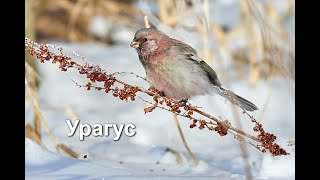
Меньше воробья, с длинным хвостом и коротким толстым клювом. В окраске самца доминирует розовый цвет с серебристо-белой «сединой» на голове. Осенью в свежем пере розовая окраска несколько замаскирована светло-бурыми каемками на покровных перьях. Окраска самки светло-серая, может быть немного охристая, со слабыми темными пестринами почти по всему телу, поясница розовая, слегка розоватая или белая; на груди и боках - розовый налет, по-разному выраженный у разных особей. Во всех нарядах на темных крыльях большие белые поля. Хвост двухцветный черно-белый, длинный, несколько укорочены внешние рулевые и центральная пара. Молодые похожи на самку, еще более пестрые, на пояснице вместо розового грязно-оранжевый или охристо-розовый цвет, белые каемки на третьестепенных маховых с охристым налетом. После линьки в августе - сентябре сохраняется охристый цвет на третьестепенных маховых; большие верхние кроющие второстепенных маховых линяют не все, есть разница между новыми и старыми, от гнездового наряда (у взрослых такой разницы нет). Эти различия сохраняются до следующего лета. Самцы-первогодки по окраске отличаются от старых более слабым розовым цветом, могут очень походить на самку, более светлые, есть хотя бы немного розового на пояснице. Вес 14-20 г, длина 16-19, крыло 6.8-7.9, размах около 20-23 см.
Distribution
Breeding in Semipalatinsk area, probably also in Kalbinskiy Altai and in Altai, in Ulba valley and on Markakol lake, where observed in summer. One female recorded at lower reaches of Bukhtarma river 20 July 2001. On dispersal and in winter occurs in Ural valley, down to Atyrau, on Syrdarya, in Naurzum Reserve, Kurgaldzhino and Karaganda, in Chu valley about Furmanovka and everywhere in foothill areas from Semipalatinsk up to Tashkent.
- I
- II
- III
- IV
- V
- VI
- VII
- VIII
- IX
- X
- XI
- XII
- Breeding
- Migration
- Wintering
Map © Birds.kz. Copying without permission is prohibited
Subspecies
- Long-tailed Rosefinch Uragus sibiricus sibiricus
Latest observations
all species photos · 805 →


Species videos · 4
all species videos · 4 →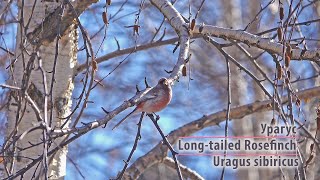


Biology
Rare resident. Inhabits the willow-birch thickets on hassock marshes with horsetail grass, sedge and other vegetation. On dispersal and wintering (until the end of April) visits the deciduous forests with bush undergrowth, the riparian forests, gardens and thickets of tall weeds. Breeds in separate pairs quite a far one from another, in non-breeding seasons is in flocks of 5-15 birds. Nest is located in bushes at height 1-2 m above the ground; nest is built from the dry grass, leaves and bast and is lined with thin parts of plants, hair and feathers. Mainly female builds the nest for 4-7 days. Clutch of 3-6 (usually 4) eggs is laid in June. Mainly female incubates clutch for 13-14 days. Both parents feed juveniles which fledge at age 13-14 days old. One brood was feeding by parents noticed in August 13, 1946 in Irtysh valley. As soon as dispersal begins in end of September - early October birds appear outside of breeding area. At Chokpak Pass one bird observed in March 6, 1970. Latest birds in spring recorded in end of March – early April.
Sources
Gavrilov E. I., Gavrilov A. E. "The Birds of Kazakhstan". Almaty, 2005. Э.И.Гаврилов. "Фауна и распространение птиц Казахстана". Алматы, 1999. В.К.Рябицев. "Птицы Урала, Приуралья и Западной Сибири". Екатеринбург. Издательство Уральского университета, 2000.