
Water Rail
Rallus aquaticus Linnaeus, 1758
Сутартар

 1 / 2
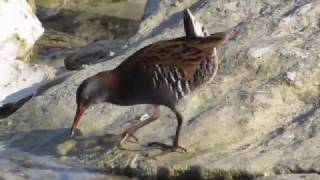
adult Almaty region, Sorbulak
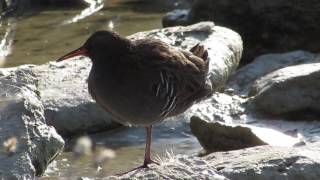
juvenile Pavlodar Area, Borly
- status in Kazakhstan
- nests here · on migration · winters here
- conservation status
- IUCN LCleast concern
- sizes
- weight 132–187 g
- when to see it
- March — Octoberwinters: November — February
- on the site
- 223 observationslast: 21 Oct 2026
- videos
- 3
Description
Adult Water Rails have olive-brownish with broad black centers upperparts, crown, wing-coverts and inner secondaries. Head-flanks, neck-flanks, throat, craw and fore-breast are grey. Body-flanks are with across broad black and narrow white strips. Rear-belly is buffy. Lower wing-coverts are with black and white strips. Long feathers of undertail are white, short ones are black with white across bars and buffy tips. Bill is brownish-black with orange-red base of lower mandible. Legs are brownish. Eyes are orange-red. First-year juveniles have upperparts dimmer than on adults; throat is whitish, other underparts are pale-buffy; across strips on body-flanks are dark-brownish and white. Second-year birds have whitish throat, other underparts are greyish-buffy; in all other plumage same to adults. Sizes: wing 95-130 mm, bill 35-45 mm, tarsus 35-47 mm. Weight 132-187 gr.
Distribution
Water Rail breeds in all parts of Kazakhstan except waterless steppes and deserts. Widespread on migration. Wintering in Southern and South-Eastern Kazakhstan. Please see detailed distribution in section Subspecies.
- I
- II
- III
- IV
- V
- VI
- VII
- VIII
- IX
- X
- XI
- XII
- Breeding
- Migration
- Wintering
Map © Birds.kz. Copying without permission is prohibited
Subspecies
- Water Rail Rallus aquaticus aquaticus
- Water Rail Rallus aquaticus korejewi
Latest observations
all species photos · 223 →


Species videos · 3
all species videos · 3 →
Biology
Water Rail is common breeding migrant, but at southern Kazakhstan resident mostly. Inhabits fresh and salty lakes, pounds and slowly moving rivers with reed-beds and reed mace tickets. Arrives in mid-March or in early April, on northern areas some later - in end of April or in early May. Breeds in pairs, not close one to another. Nest is built above the water of deepness to the pint of one meter; nest built on the base of reed bunch or other vegetation, between the willow thicket; from the old reed, reed mace and other leaves. The base of nest disposes at 10-15 cm above the water, but in some cases touched water. Clutches of 3-8 eggs in May - early June. Double brooded, renesting after loss of first clutches isn't rare. Both parents begin incubate when a clutches is still not full, during 19-21 days. Juveniles hatch in June - July. Autumn migration begins in September, and northern areas birds leave in mid-October, but in southern areas of Kazakhstan Water Rail winters.
Sources
"Птицы Казахстана" том 1, Алма-Ата, 1960
Э.И.Гаврилов. "Фауна и распространение птиц Казахстана". Алматы, 1999.
Gavrilov E. I., Gavrilov A. E. "The Birds of Kazakhstan". Almaty, 2005.
Э.И.Гаврилов. "Фауна и распространение птиц Казахстана". Алматы, 1999.
Gavrilov E. I., Gavrilov A. E. "The Birds of Kazakhstan". Almaty, 2005.