
Carrion Crow
Corvus corone Linnaeus, 1758
Қара қарға

 1 / 2
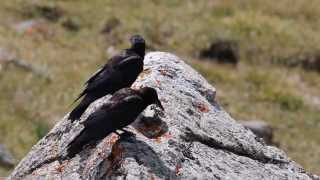
adult Almaty region
juveniles Almaty, Butakovka
- status in Kazakhstan
- nests here · on migration · winters here
- conservation status
- IUCN LCleast concern
- sizes
- 50–57 cm, wingspan 90–105 cmweight 500–750 g
- when to see it
- March — Octoberwinters: November — February
- on the site
- 857 observationslast: 25 Oct 2026
- videos
- 2
Description
Телосложением, размерами и пропорциями - копия серой вороны, но все оперение черное, с металлическим блеском. От ворона отличается меньшими размерами, слабо закругленным (не клиновидным) хвостом, более легкой головой, с не столь мощным клювом. Легче всего спутать с молодым грачем, от которого следует отличать по более плотному телосложению, более мощному клюву (конек надклювья имеет резкий изгиб книзу у вершины), "штанов" нет (т.е. перья на боках не удлинены), перья на темени не приподняты, так что голова "плоская", с плавным закруглением от клюва к затылку. Самец и самка внешне не отличаются. Молодые похожи на взрослых, отличаются более рыхлым оперением, с более слабым блеском. Вес 500-750 г, длина 50-57, крыло 32.7-41.2, размах 90-105 см.
Distribution
Breeds in mountains and foothills of southwest Altai and Kalbinskiy Altai, Saur, Dzhungarskiy Alatau and Tien Shan; in Zaysan and Balkhash-Alakol depressions and in Southern Trans-Balkhash area, in Chu river valley, lower Sarysu river and in Syrdarya valley river. In this part of Kazakhstan it ranges in north to lower Turgay river and Ulkayak river. In years when Turgay lakes are dry out (1940-1950), it nests in Naurzum Reserve. Wandering and wintering birds also recorded within this range. Migrating birds observed at Ustyurt, on Mugodzhary ridge, and vagrants recorded in Kokchetav uplands.
- I
- II
- III
- IV
- V
- VI
- VII
- VIII
- IX
- X
- XI
- XII
- Breeding
- Migration
- Wintering
Map © Birds.kz. Copying without permission is prohibited
Subspecies
- Carrion Crow Corvus corone orientalis
- Hybrid Crow Corvus (corone x cornix)
Latest observations
all species photos · 857 →


Species videos · 2
all species videos · 2 →
Biology
Common resident. Inhabits riparian forests, groves, shelterbelts and reed-beds on plains; and deciduous, mixed and coniferous forests in mountains at altitudes up to 2600 m in Tien Shan and 2200 m in Altai, mostly near the water. Appears in breeding sites in March. Breeds in separate pairs at 100-150 m, or sometimes 8-10 km one from another. Nest is located on tree (spruce, juniper, elm, apple, poplar, russian olive, willow, birch, larch) at height 2-25 m above the ground; or on tamarisk bushes and reed clump; nest is built from twigs or reed stems and leaves, and is lined with plenty of hair. Clutch of 3-6 eggs is laid between late March and late May. Both parents feed juveniles which fledge in late May – early July. Repeated breeding after loss of the first clutch is common. Autumn movement begins in late September – early October. At Chokpak Pass singly birds rarely caught in October. Records of flocks of several hundred birds need confirmation, as they can be confused with Rooks especially in autumn.
Sources
Gavrilov E. I., Gavrilov A. E. "The Birds of Kazakhstan". Almaty, 2005. Э.И.Гаврилов. "Фауна и распространение птиц Казахстана". Алматы, 1999. В.К.Рябицев. "Птицы Урала, Приуралья и Западной Сибири". Екатеринбург. Изд-во Уральского университета, 2000.