Hooded Crow
Corvus cornix Linnaeus, 1758
Ала қарға

 1 / 2
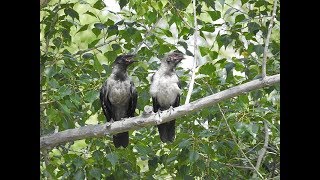
adult Shardara, Yuzhno Kazakhstanskaya obl.
juvenile Pavlodar
- status in Kazakhstan
- nests here · on migration · winters here
- sizes
- 44–51 cm, wingspan 87–102 cmweight 430–740 g
- when to see it
- February — Novemberwinters: December — January
- on the site
- 924 observationslast: 5 Nov 2026
- videos
- 3
Description
Общеизвестная птица с серым оперением туловища и черными головой, крыльями и хвостом. Сходных видов нет. Самец и самка внешне не отличаются, самцы в среднем несколько крупнее. Молодые похожи на взрослых уже после вылета из гнезда, но серый цвет у них темнее и с бурым оттенком, а черный - без блеска. Есть возрастные отличия, которые можно разглядеть, когда птица в руках: у молодых глаза буровато-серые, ротовая полость белая, у второгодков глаза коричневые, полость рта белая или пятнистая; у взрослых глаза темно-коричневые или почти черные, полость рта серая или (у более старых) черная. Вес 430-740 г, длина 44-51, крыло 29.2-35.5, размах 87-102 см.
Distribution
In Kazakhstan the Hooded Crow nests in the northern half of the country both in the steppe forests and steppe lakes. In winter numerous Hooded Crows centered around the human settlements in the south of Kazakhstan. More detailed distribution in Kazakhstan, please see in Subspecies section.
- I
- II
- III
- IV
- V
- VI
- VII
- VIII
- IX
- X
- XI
- XII
- Breeding
- Migration
- Wintering
Map © Birds.kz. Copying without permission is prohibited
Subspecies
- Hooded Crow Corvus cornix cornix
- Hooded Crow Corvus cornix sharpii
Latest observations
all species photos · 924 →
 2


Species videos · 3
all species videos · 3 →

Biology
Common resident (in northern regions) / winter visitor (in southern regions). Inhabits deciduous, mixed and coniferous forests, groves, shelterbelts, birch and pine forest-patches, bush thickets and reed beds in rivers, lakes and marshes; mostly on plains, low mountains and in Altai foothills up to 550 m. It free hybridizes with Carrion Crow, in 1958 on Markakol lake (1450 m) the hybrid birds were dominant, but since 1966 only Carrion Crow were recorded. During migration and wintering occurs in open lands, villages and towns, on dumps, stubble fields and also near farms. Spring migration begins in late February – early March, most birds (of northern populations probably) flies off from southern areas in March; last birds recorded at Chokpak Pass in late April – mid May. Occurs mostly in flocks of several dozen birds, gathering in thousands at roost sites. Appears in March at breeding sites. Breeds in separate pairs at 100-250 m one from another. Nest is located on tree (poplar, elm, pine, spruce, birch, asp) or bush (willow, tamarisk, Nitraria sp.) at height 0.5-15 m above the ground, or on the old reed heaps, geodesic towers, ruins of human construction in treeless county. Both partners repair old nest or build new one from the twigs and lined it with hair, some rags and pieces of paper. Clutch of 2-7, usually 5-6 eggs are laid from early April to end of May. Probably only female incubates about 17-19 days. Both parents feed juveniles which fledge at age 32-33 days, in late May – early July. Repeated breeding after loss of first clutch is common. Autumn wandering begins in late July to early August. Migration (of northern populations probably) begins in mid – end September, most birds appears in southern areas n October - November.
Sources
Gavrilov E. I., Gavrilov A. E. "The Birds of Kazakhstan". Almaty, 2005. Э.И.Гаврилов. "Фауна и распространение птиц Казахстана". Алматы, 1999. В.К.Рябицев. "Птицы Урала, Приуралья и Западной Сибири". Екатеринбург. Изд-во Уральского университета, 2000.