Common Rosefinch
Carpodacus erythrinus Pallas, 1770
Кәдімгі құралай

 1 / 2
male Kastek Gorge, Almaty region
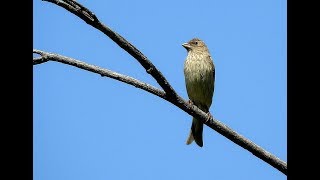
female South Kazakhstan, Aksu-Dzabagly nature reserve.
- status in Kazakhstan
- nests here · on migration
- conservation status
- IUCN LCleast concern
- sizes
- 13–18 cm, wingspan 24–28 cmweight 16–26 g
- when to see it
- April — September
- on the site
- 935 observationslast: 6 Aug 2026
- videos
- 4
Description
Самец имеет характерную малиново-красную окраску головы, поясницы и груди. На боках и низе груди красный цвет постепенно сходит на нет, брюхо беловатое. Крылья, спина и хвост бурые, с большим или меньшим участием красного. Брачное оперение сохраняется до отлета, линяют на местах зимовки. Годовалый (второго календарного года) самец имеет самочью окраску. Самка сверху оливково-бурая, с небольшими темными наствольными штрихами, снизу беловатая, с густыми пестринами на горле и груди. Отличается от самки домового воробья наличием пестрин на нижней стороне тела и отсутствием охристого рисунка на передней части спины, более толстым клювом, выемчатым хвостом. От самки коноплянки отличается крупными размерами, толстым клювом, оливковым оттенком оперения, отсутствием белого поля на сложенном крыле и белых пятен по бокам хвоста. Молодые похожи на самку, но по всему оперению интенсивный желтый или охристый налет, на спине крупные темные пестрины, светлые крыловые полоски охристые или желтые (у взрослой самки - беловатые), в этом наряде молодые улетают на юг. Вес 16-26 г, длина 13-18, крыло 7.7-9.0, размах 24-28 см.
Distribution
In Kazakhstan breeds everywhere in steppe-forests zone, and in mountain forests of Tien Shan, Altai and Kazakh Upland. Please see detailed distribution in Subspecies section.
- I
- II
- III
- IV
- V
- VI
- VII
- VIII
- IX
- X
- XI
- XII
- Breeding
- Migration
- Wintering
Map © Birds.kz. Copying without permission is prohibited
Subspecies
- Common Rosefinch Carpodacus erythrinus erythrinus
- Common Rosefinch Carpodacus erythrinus grebnitzkii
- Common Rosefinch Carpodacus erythrinus ferghanensis
Latest observations
all species photos · 935 →

 3
 4
Species videos · 4
all species videos · 4 →


Biology
Common breeding migrant. Inhabits the bush thickets, forest edges, light forests, pine-birch forests with bush undergrowth on plains. In mountains lives from the deciduous forest belt to juniper belt (at 2000-2800 m in Western Tien Shan, 1300-2750 m in Zailiyskiy Alatau, and from foothills up to 2200 m in Altai), prefers the places nearby the water. On migration occurs in reed-beds, bushes, shelterbelts, gardens, and in the thickets of tall weeds near cereal fields. Arrives in the end of April – early May in southern regions and in early – mid-May in northern ones. In foothills of Western Tien Shan the intensive flight in flocks of 10-20 (rare 100-200) birds occurs in May when the elm seeds are available to feed (but in autumn migrates through the mountain mostly). Latest spring migrants recorded in early – mid-June, sometimes in late June. On breeding places appears in end of May – early June. Breeds in separate pairs at distance 15-60 m from each other. Only female builds (male escorts her) the nest for 3-4 days in bush (honeysuckle, dogrose, barberry, lilac, elder) or in tree (spruce, fir, birch, elm, apple and maple) at height 0.5-4 m above the ground; nest is built from the thin twigs and dry grass and is lined with rootlets and hair. Clutch of 3-5 eggs is laid in mid-June to end of July. Only female incubates clutch for 13-14 days. Both parents feed juveniles which fledge at age 13-17 days old. Rears one brood per season. Autumn migration begins in late July – early August, in eastern Kazakhstan Common Rosefinches fly mainly through mountains. At Chokpak Pass the morning mass flight recorded once only, in August 30-31, 1992, when 829 Rosefinches were ringed. In northern areas disappears in end of September, but in southern ones the latest birds were recorded in October 20, 1968 and in November 10, 1964.
Sources
Gavrilov E. I., Gavrilov A. E. "The Birds of Kazakhstan". Almaty, 2005. Э.И.Гаврилов. "Фауна и распространение птиц Казахстана". Алматы, 1999. В.К.Рябицев. "Птицы Урала, Приуралья и Западной Сибири". Екатеринбург. Издательство Уральского университета, 2000.