
Spotted Nutcracker
Nucifraga caryocatactes Linnaeus, 1758
Самыркеш

Kim-Asar gorge, Ile Alatau National Park
- status in Kazakhstan
- nests here · on migration · winters here
- conservation status
- IUCN LCleast concern
- sizes
- 27–38 cm, wingspan 50–61 cmweight 120–200 g
- when to see it
- April — Octoberwinters: November — March
- on the site
- 342 observationslast: 4 Nov 2026
- videos
- 2
Description
Большеголовая и большеклювая птица размером примерно с сойку. Окраска туловища темно-бурая, с многочисленными каплевидными белыми пестринами, шапочка и крылья черные, подхвостье белое, по краю хвоста белая полоса, на крайних рулевых - более широкая. Самец и самка внешне неотличимы. Молодые похожи на взрослых, но в гнездовом наряде (до летней линьки) пятна не белые, а слегка охристые или буроватые. Вес 120-200 г, длина 27-38, крыло 17.7-19,1, размах 50-61 см.
Distribution
Lives in the Eurasian taiga forests and spruce forests of Tien Shan. In Kazakhstan breeds in Altai, Dzhungar Alatau and ridges of Northern Tien Shan. Please see detailed distribution in the section Subspecies.
- I
- II
- III
- IV
- V
- VI
- VII
- VIII
- IX
- X
- XI
- XII
- Breeding
- Migration
- Wintering
Map © Birds.kz. Copying without permission is prohibited
Subspecies
- Spotted Nutcracker Nucifraga caryocatactes rothschildi
- Spotted Nutcracker Nucifraga caryocatactes macrorhynchos
Latest observations
all species photos · 342 →


Species videos · 2
all species videos · 2 →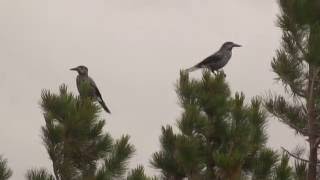

Biology
Common, in places rare, resident. Inhabits mountain cedar and spruce forests at altitudes 1700-2700 m in Tien Shan and 900-2200 m in Altai. During non-breeding seasons wanders quite widely and occurs in the deciduous forest, groves and gardens and exceptionally in the clay deserts with scattered bushes. Breeding in separate pairs. Nest is built in a tree (spruce, cedar, larch) at height 1-8 m above the ground; nest is from the dry twigs, lichen and willow bast and is lined with dry grass, plant fluff and some hair and feathers. Clutch of 3-4, rare up to 7, eggs is laid probably in end April – May. Both parents incubate clutch for about 20 days and feed juveniles, which fledge in mid – end June. Most of the year stays singly or in loose groups. In case of crop failure of cones of coniferous species which are the main food to Nutcrackers, the birds of subspecies macrorhynchos wanders wide to west and south in mid September - October, but such behaviour was not recorded for birds of subspecies rothschildi.
Sources
Gavrilov E. I., Gavrilov A. E. "The Birds of Kazakhstan". Almaty, 2005. Э.И.Гаврилов. "Фауна и распространение птиц Казахстана". Алматы, 1999. В.К.Рябицев. "Птицы Урала, Приуралья и Западной Сибири". Екатеринбург. Изд-во Уральского университета, 2000.