
Siberian Stonechat
Saxicola maurus Pallas, 1773
Қарабас шақшақ


 1 / 3
spring male Усть-Каменогорск
autumn male Almaty, Republic Square
female Ust-Kamenogorsk, KShT
- status in Kazakhstan
- nests here · on migration
- sizes
- 12–13 cm, wingspan 18–21 cmweight 11–18 g
- when to see it
- March — October
- on the site
- 1735 observationslast: 26 Oct 2026
- videos
- 2
Description
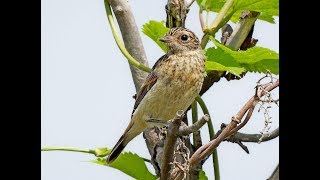
Stonechat is the small less than sparrow bird. On constitution it is similar to Whinchat but a bit lesser and has longer tail and more round head. Spring male has the black head with the white collar, the reddish-rufous breast and the white or light-buffy rump. Female is buffy-rufous with the some darker upperparts. Female distinguishes on Whinchat female by a bit exposes of light supersilium, has not light patches on the tail's sides and has buffy or light-rufous color on the rump and the uppertail looking as a light patch. Juveniles on first plumage are similar to female but more dappled with light buffy streaks on crown, back and wings and with dark spots on underparts. Autumn males and juveniles are similar to females, but males have the white with rufous spots uppertail, more light than on females. As the Whinchat it has white patch on the shoulders part on all plumages but it has not white spots on the tail's sides. The rump and the uppertail are lighter that back. The tail is frequently fanned. Weight 11-18 grams, length about 12-13, wing 6,7-7,4, wingspan 18-21 sm.
Distribution
Several races of the Stonechat live in different parts of Europe, Asia and Africa. It is common or numerous bird in most parts of the range. In Kazakhstan it breeds widespread except waterless areas of Trans-Caspian and Trans-Aral deserts. In the mountains breeds up to 3000 meters. Please see the detailed distribution in Kazakhstan in the chapter "Subspecies".
- I
- II
- III
- IV
- V
- VI
- VII
- VIII
- IX
- X
- XI
- XII
- Breeding
- Migration
- Wintering
Map © Birds.kz. Copying without permission is prohibited
Subspecies
- Caspian Stonechat Saxicola maurus hemprichii
- Siberian Stonechat Saxicola maurus maurus
Latest observations
all species photos · 1735 → 2


 2
Species videos · 2
all species videos · 2 →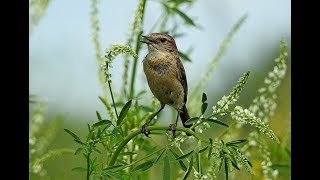
Biology
Abundant, in places common breeding migrant. Inhabits open meadow and steppe places with bushes and height grass, edges of riparian and deciduous forest, kitchen-gardens on plains, and easy mountain slopes with some bushes and height grass up to 2300 m in Altai and 3000-3200 m in Tien Shan. In southern areas appears in March – early April in loose flocks of 15-25 birds. Majority of birds migrate in April. In northern areas and in mountains arrives in April – mid-May. Breeds in separate pairs not far one from another. Nest is built on ground under bush, grass or stone from dry grass lined with hair and feathers. Only female builds nest, male escorts her. Clutches of 3-6 eggs found in end April – late June. Female incubates for 11-14 days. Both parents feed juveniles which fledge at 12 days old in early June – end July. The long breeding period is explained by the large latitude of distribution, the belated phenology in the highlands, the repeated breeding after the loss of the first nest, and the probable two breeding cycles on plains. Autumn migration in highlands is on early in late July – August, latest birds recorded in end August. On plains basic migration is in late August – first half of September, latest birds observed in mid-October.
Sources
В.К.Рябицев. "Птицы Урала, Приуралья и Западной Сибири". Екатеринбург, Изд-во Уральского университета, 2000. <br> Э.И.Гаврилов. "Фауна и распространение птиц Казахстана". Алматы, 1999. <br> Gavrilov E. I., Gavrilov A. E. "The Birds of Kazakhstan". Almaty, 2005. <br> А.Ф.Ковшарь "Певчие птицы". Алма-Ата, "Кайнар", 1983.