
Northern Wheatear
Oenanthe oenanthe Linnaeus, 1758
Сұр шақшақай


 1 / 3
male Ile river canyon, Almaty oblast.
female Ust-Kamenogorsk, KShT
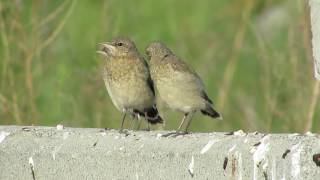
juvenile Shakat vicinity, Pavlodar region, Pavlodar oblast
- status in Kazakhstan
- nests here · on migration
- conservation status
- IUCN LCleast concern
- sizes
- 15–18 cm, wingspan 28–32 cmweight 18–30 g
- when to see it
- March — October
- on the site
- 1178 observationslast: 4 Aug 2026
- videos
- 2
Description
The Northern Wheatear is lesser than sparrow. The male on breeding plumage has grey upperparts, light-rufous or buffish breast following in white on abdomen, black wings, face mask and inverted T-pattern at the end of the tail, white rump and uppertail. The female is much more pale and has indistinct brownish mask, rufous- or gray-brownish upperparts, dark-brown wings and rufous, buffy or brownish ton on the breast. There are females dimmer and brighter as males. In autumn it resembles the female apart from the black wings. The Northern Wheatear moves by hops with abrupt stops, often curtseys and tail fanning that is characteristic to all wheatears. It flies low over the earth, flight is original dancing. On the flight the white spot on the base of the tail and the uppertail is well appreciable. It prefers to sit on large stones, hillocks, poles, constructions. Weight 18-30 grams, length 15-18, wing 8,8-10,5, wingspan 28-32 cm.
Distribution
The Northern Wheatear inhabits most parts of Eurasia. In Kazakhstan it breeds throughout both on plains and in highland, from Volga-Ural area up to Altai (Katon-Karagay), Dzhungarskiy Alatau and Tien Shan (Talasskiy, Kirgizskiy and Zailiyskiy Alatau ranges, and also in Karatau). It doesn't live on Mangyshlak, in Kyzylkum, Betpak-Dala, Muyunkum desert, Chu-Iliyskiye Mts. and area adjacent to Balkhash lake. On migration occurs throughout.
- I
- II
- III
- IV
- V
- VI
- VII
- VIII
- IX
- X
- XI
- XII
- Breeding
- Migration
- Wintering
Map © Birds.kz. Copying without permission is prohibited
Subspecies
- Northern Wheatear Oenanthe oenanthe oenanthe
Latest observations
all species photos · 1178 →


Species videos · 2
all species videos · 2 →
Biology
The Northern Wheatear is common breeding migrant. It inhabits steppes, semi-deserts and clay deserts with the low grass and abundant Ground Squirrels and Marmots, the overgrazing places near villages, the alpine belt in mountains to 3000-3300 m in Tien Shan. On migration it visits open places. Arrives in the end March – early April in the southern areas of the range, and in the mid-April – early May in the northern ones and in the highlands. Breeds in the separate pairs far one to another. Nest is built in the uninhabited burrows of rodents or of Sand Martin, under the stones and the bridge, in the stone piles, in the ruins. Only female builds it from dry grass and plenty lines it with the hairs and feathers. Clutches of 4-7 usually 5-6 eggs are from end April to late June. Both parents feed juveniles, which fledge in end May – mid-August. After leaving the burrow the juveniles long time keep close in it on danger. On plains two broods per summer are probable, but in the mountains one only. Both adults and juveniles eat insects. Autumn migration starts in August, majority of birds leaves in September, latest birds recorded in mid – end October.
Sources
В.К.Рябицев. "Птицы Урала, Приуралья и Западной Сибири". Екатеринбург, Изд-во Уральского университета, 2000.
Э.И.Гаврилов. "Фауна и распространение птиц Казахстана". Алматы, 1999.
Gavrilov E. I., Gavrilov A. E. "The Birds of Kazakhstan". Almaty, 2005.
А.Ф.Ковшарь "Певчие птицы". Алма-Ата, "Кайнар", 1983.
Э.И.Гаврилов. "Фауна и распространение птиц Казахстана". Алматы, 1999.
Gavrilov E. I., Gavrilov A. E. "The Birds of Kazakhstan". Almaty, 2005.
А.Ф.Ковшарь "Певчие птицы". Алма-Ата, "Кайнар", 1983.