
Whooper Swan
Red Book of the Republic of Kazakhstan
Category II · declining species
Cygnus cygnus Linnaeus, 1758
Сұңқылдақ аққу

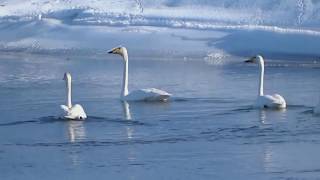
adult Zharasbay, Karaganda province
- status in Kazakhstan
- nests here · on migration · winters here
- conservation status
- Red Book of Kazakhstan · II IUCN LCleast concern
- sizes
- 145–160 cm, wingspan 218–243 cmweight 5–10 kg
- when to see it
- February — Novemberwinters: December — January
- on the site
- 702 observationslast: 5 Nov 2026
- videos
- 4
Description
Клюв желтый с черным, причем желтый цвет занимает гораздо больше половины площади клюва и заходит на черную вершину отчетливым острым углом, чем кликун наиболее достоверно отличается от малого лебедя. Различия в размерах этих видов существенны, но отчетливо видны только когда кликуны и малые лебеди находятся рядом. От лебедя-шипуна отличается окраской клюва, издали следует обращать внимание на манеру плавания: у кликуна крылья плотно уложены на спине, шея обычно прямая, "палкой". У молодых кликунов (в первую осень) клюв розовато-серый с более темной вершиной. Вес 5-10, иногда до 14 кг, длина 145-160, крыло самцов 58.7- 63.5, самок - 56.2-61.5, размах 218-243 см.
Distribution
Breeds in northern half of Kazakhstan; south to lower reaches of Turgay river and Balkhash-Alakol depression; sometimes lives in deltas Ili and Lepsy, on Sasykkol lake and on Markakol lake. Isolated breeding is known at Tekesskiy reservoir in Central Tien Shan. On migration occurs everywhere throughout plains of Kazakhstan. Winters on Northern Caspian Sea, sometimes to the south of Turkestan and Shymkent, in recent years on Sorbulak lake.
- I
- II
- III
- IV
- V
- VI
- VII
- VIII
- IX
- X
- XI
- XII
- Breeding
- Migration
- Wintering
Map © Birds.kz. Copying without permission is prohibited
Latest observations
all species photos · 702 → 4


Species videos · 4
all species videos · 4 →


Biology
Common breeding migrant. Inhabits large fresh and slightly salty lakes with vast reed beds. Appears very early, when lakes not yet free from ice, mid – end February or early March in southern areas, and in early – end April in central and northern ones. Migrates in small flocks, rarely more than 50 birds. At breeding sites they arrive in pairs and don’t nest close to one another. A large nest is built among reed and mace beds and constructed from dry stems of reed and other vegetation. Inner cup lined with dry stems of reed, mace and sedge. Clutches of 3-7, more often of 4-6 eggs in early April – end May. Only female incubates 35-40 days. Juveniles hatch mid-May – June. Both parents rear juveniles. Autumn migration from end August to end October – early December.
Sources
Gavrilov E. I., Gavrilov A. E. "The Birds of Kazakhstan". Almaty, 2005. Э.И.Гаврилов. "Фауна и распространение птиц Казахстана". Алматы, 1999. В.К.Рябицев. "Птицы Урала, Приуралья и Западной Сибири". Екатеринбург. Изд-во Уральского университета, 2000.