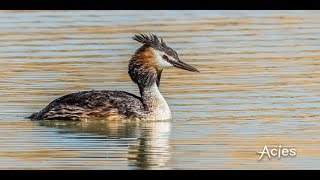
Great Crested Grebe
Podiceps cristatus Linnaeus, 1758
Үлкен сұқсыр


 1 / 3
spring Aspara, Merke region, Zhambyl oblast
winter Zhylandy cape, Mangystau.
juvenile Baiserke, Ile region, Almaty oblast
- status in Kazakhstan
- nests here · on migration · winters here
- conservation status
- IUCN LCleast concern
- sizes
- 46–51 cm, wingspan 85–95 cmweight 0.6–1.5 kg
- when to see it
- February — Octoberwinters: November — January
- on the site
- 906 observationslast: 27 Oct 2026
- videos
- 7
Description
Самая крупная из поганок, с крякву, но стройнее. От серощекой поганки весной и в начале лета отличается пышными воротником и "ушами", в осеннем пере - чисто белой передней стороной шеи, наличием белой полосы выше глаза и темной "уздечки", красноватым клювом. У молодых до осени сохраняются полосы на голове. В отличие от молодых серощеких поганок, полосы спускаются и на шею. Глаза у взрослых птиц красные, у молодых - розовые. На крыле у всех птиц белое зеркало и белое пятно на переднем крае крыла, смыкающееся по основанию крыла с зеркалом. Вес 570-1500 г, длина 46-51, крыло 16.8-20.9, размах 85-95 см.
Distribution
Breeding and migrating on lakes and reservoirs throughout Kazakhstan, including southern Altai (Markakol lake) but excluding arid Mangyshlak and deserts where reservoirs are absent. Wintering in small numbers in south Kazakhstan, in the lower reaches of Arys, Keles, on Syrdarya rivers and in the Caspian Sea. In mild years wintering on Aral Sea at Barsa-Kelmes and on Sorbulak lake where 12 birds recorded 15 December 2002.
- I
- II
- III
- IV
- V
- VI
- VII
- VIII
- IX
- X
- XI
- XII
- Breeding
- Migration
- Wintering
Map © Birds.kz. Copying without permission is prohibited
Subspecies
- Great Crested Grebe Podiceps cristatus cristatus
Latest observations
all species photos · 906 →


Species videos · 7
all species videos · 7 →


Biology
Numerous and common breeding migrant. Inhabits large fresh or brackish lakes with reed-beds, reed mace, cane and other vegetation. Prefers lakes with fish, but sometimes occurs on water without fish . On large lakes (eg. on Alakol lake) often well away from reed-beds. Appears end February – early March in south Kazakhstan, or at end April – early May in the northern areas. Migrates singly, in pairs or in small flocks of 6-8 birds. Breeding in single pairs begins approximately one month after arrival. Nest built among floating vegetation mainly, but sometimes at fixed sites, from reed stems, leaves, reed mace, rush, algae and other material. Clutches of 3-7 eggs from end of April to mid-July. Broods from 3-4, less often 1 or 5-6 juveniles observed from end May through August – early September. Both parents care for chicks. Repeated breeding after loss of clutches is common. In autumn migrates mainly in small groups of up to 10-14 individuals but along northern coasts of Caspian Sea, huge numbers gather. Autumn dispersal begins in late July; migration occurs from end August through October - early November, when reservoirs freeze up.
Sources
Gavrilov E. I., Gavrilov A. E. "The Birds of Kazakhstan". Almaty, 2005. Э.И.Гаврилов. "Фауна и распространение птиц Казахстана". Алматы, 1999. В.К.Рябицев. "Птицы Урала, Приуралья и Западной Сибири". Екатеринбург. Изд-во Уральского университета, 2000.