
Black-Necked Grebe
Podiceps nigricollis C.L.Brehm, 1831
Қарамойын сұқсыр


 1 / 3
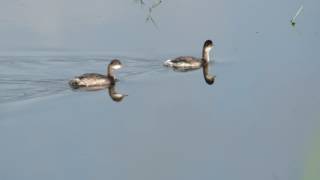
summer Sorbulak lake, Almaty region
juvenile Ust-Kamenogorsk
winter plumage Aktau. seafront.
- status in Kazakhstan
- nests here · on migration · winters here
- conservation status
- IUCN LCleast concern
- sizes
- 28–34 cm, wingspan 56–60 cmweight 200–450 g
- when to see it
- April — Novemberwinters: December — March
- on the site
- 647 observationslast: 15 Sep 2026
- videos
- 5
Description
Размером меньше чирка-свистунка. От красношейной поганки в брачное время отличается черной шеей, формой и расцветкой хохла. В осеннем пере наиболее надежно отличаются от красношейной поганки формой клюва: он отчетливо вздернутый, с чуть прогнутым коньком надклювья; кроме того, отличаются большим наличием серого цвета на передней стороне шеи, темная шапочка опускается на щеку, закрывая ухо. Молодые осенью похожи на взрослых, но серый цвет на шее с рыжиной и доходит до верха груди, вблизи заметны пестрины по бокам головы. У молодых глаза коричневые, у взрослых - ярко-красные. Все эти признаки видны с относительно небольшого расстояния. На крыле только одно белое поле - зеркало по заднему краю крыла, захватывающее не только второстепенные, но и несколько внутренних первостепенных маховых. Вес 200-450 г, длина 28-34, крыло 12.4-13.9, размах 56-60 см.
Distribution
Breeding throughout Kazakhstan both on plains and in mountains (Markakol lake), excluding arid Mangyshlak and deserts; on migration occasionally visits high mountain lakes (Big Almaty lake, 4 September 1971, 9-11 August 1973, 6 June 1976).
- I
- II
- III
- IV
- V
- VI
- VII
- VIII
- IX
- X
- XI
- XII
- Breeding
- Migration
- Wintering
Map © Birds.kz. Copying without permission is prohibited
Subspecies
- Black-Necked Grebe Podiceps nigricollis nigricollis
Latest observations
all species photos · 647 →


Species videos · 5
all species videos · 5 →


Biology
Common, locally numerous breeding migrant. Inhabits lakes and slow-flowing steppe rivers and spill overs with reed, cane, reed-mace and other vegetation on plains and in mountains up to 1450 m in Altai region. On migration recorded on open reservoirs, usually in flocks of 10 -15, occasionally up to 100 birds. Breeding in colonies of some hundreds or tens of pairs, often with gulls and terns. Appears in mid-April – early May at southern areas, and end April – mid-May at northern regions. Breeding begins in mid-May. Floating nests are built among vegetation though on Sorbulak lake birds have been observed to construct nests on sandy shores of small islands (perhaps observed when water level drops and birds continue incubating). Both parents build nest from decayed wet stems and leaves. Clutches usually 3-5 eggs, but up to 8, and repeated clutches found from mid-May to early July. Juveniles noted from mid-June till August. Both parents care for juveniles. Small chicks often observed sitting on back of one adult, while the other adult dives for food to feed youngsters. Repeated breeding after loss of clutches is common. Autumn migration begins in mid-August and finishes in the first week of November. Wintering in small numbers in lower reaches of Arys, Keles rivers and on Syrdarya river at Chinaz, and also in the Caspian Sea.
Sources
Gavrilov E. I., Gavrilov A. E. "The Birds of Kazakhstan". Almaty, 2005. Э.И.Гаврилов. "Фауна и распространение птиц Казахстана". Алматы, 1999. В.К.Рябицев. "Птицы Урала, Приуралья и Западной Сибири". Екатеринбург. Изд-во Уральского университета, 2000.