
Wood Sandpiper
Tringa glareola Linnaeus, 1758
Бөрте балшықшы

 1 / 2
adult Pavlodar obl., Krasnovka
adult and juvenile Sorbulak lake, Almaty oblast
- status in Kazakhstan
- on migration
- conservation status
- IUCN LCleast concern
- sizes
- 19–21 cm, wingspan 36–40 cmweight 52–96 g
- when to see it
- April — September
- on the site
- 740 observationslast: 26 Oct 2026
- videos
- 2
Description
Размером с дрозда. Верх буровато-серый, с белыми пестринами, низ белый, с темными пестринами на груди и боках. Ноги желтовато- или зеленовато-серые. Поясница и надхвостье белые, спина одного цвета с крыльями (как у черныша). Самец и самка окрашены одинаково. Похожа на черныша, отличается более светлым и очень пестрым верхом, длинной (заходит за глаза) светлой бровью, более длинноногая и стройная, в полете - светлыми подкрыльями. От поручейника отличается более короткими ногами и более коротким клювом (около половины длины головы), белый цвет с поясницы не заходит на спину. У молодых есть легкий охристый налет на верхней стороне тела и на груди. Большинство взрослых улетает на зимовки еще в брачном пере, но у части птиц в середине июля - августе начинается смена оперения на зимнее. Оно похоже на оперение молодых, но с менее выраженными рыжеватыми пестринами сверху и слабым, размытым опестрением груди. Вес 52-96 г, длина 19-21, крыло 12.0-13.4, размах 36-40 см.
Distribution
Probably bred in 1966 on Markakol lake (displaying male observed on June 2 1966) and on Shoptykol lake (female with two brood patches collected 22 June 1966), but the next years only late migrants were observed. On Irtysh near Chernoyarka village the bird with the territorial behaviour was observed on June 15, 1982. In source of Kara-Kaba river (2100-2200 m) on small lakes the several disquiet birds were observed from 28 June to 2 July 2004, the nest not found. On migration occurs everywhere in Kazakhstan, on plains and in mountains.
- I
- II
- III
- IV
- V
- VI
- VII
- VIII
- IX
- X
- XI
- XII
- Breeding
- Migration
- Wintering
Map © Birds.kz. Copying without permission is prohibited
Latest observations
all species photos · 740 →


Species videos · 2
all species videos · 2 →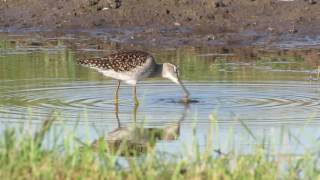

Biology
Common (in places abundant) passage migrant, and probably accidental breeding migrant on Altai. Inhabits the river meadows. On seasonal migrations occurs on the shores of rivers, lakes and other waters. In spring appears in mid-March – early April at southern areas, and in April – early May at northern ones; arrived in small groups or flocks of up to one-two dozen birds. Latest spring migrants observed in the end of May – early June. Breeds in separate pairs on marshes. Female with the brood patch was shot on June 22, 1966. In the end of June juveniles with not full grown wings were recorded. The autumn migration begins in July, at first the adults migrate, next juveniles migrate. Latest birds observed in mid-September.
Sources
Gavrilov E. I., Gavrilov A. E. "The Birds of Kazakhstan". Almaty, 2005. Э.И.Гаврилов. "Фауна и распространение птиц Казахстана". Алматы, 1999. В.К.Рябицев. "Птицы Урала, Приуралья и Западной Сибири". Екатеринбург. Изд-во Уральского университета, 2000.