
Eurasian Hobby
Falco subbuteo Linnaeus, 1758
Жағалтай

 1 / 2
adult Kaptshagai
juvenile Kaptshagai
- status in Kazakhstan
- nests here · on migration
- conservation status
- IUCN LCleast concern
- sizes
- 28–38 cm, wingspan 70–92 cmweight 130–240 g
- when to see it
- April — October
- on the site
- 924 observationslast: 12 Sep 2026
- videos
- 6
Description
Размером с голубя. Сверху темно-сизого цвета, с черными маховыми и верхом головы. Похож на сапсана общим характером окраски и особенно черными "усами", отличается от него величиной, более изящным телосложением, продольными пестринами на нижней стороне тела, красно-рыжим цветом "штанов" и подхвостья. Самка крупнее самца, сверху буроватая. У молодых "штаны" не красные, а одного цвета с остальным низом, пестрины снизу крупные, верх головы и спина темно-бурые, с четкими рыжими каемками на перьях. Их можно спутать с молодыми сапсанами, следует отличать по рыжеватой "шапочке", большому белому пятну на щеке и по пропорциям. Полет сильный и быстрый, силуэтом летящий чеглок несколько напоминает стрижа: сложенный недлинный хвост и заметно направленные назад концы длинных крыльев. Центральная пара рулевых может слегка выдаваться за общий обрез хвоста. Иногда парят на расправленных крыльях и с раскрытым хвостом, очень редко "трясутся" подобно пустельге. Вес самцов 130-240, самок - 140-340 г, длина 28-38, крыло самцов 23.7-27.9, самок - 24.8-29.6, размах 70-92 см.
Distribution
Breeds and occurs on migration throughout in landscapes where trees and shrubs alternate with the open places.
- I
- II
- III
- IV
- V
- VI
- VII
- VIII
- IX
- X
- XI
- XII
- Breeding
- Migration
- Wintering
Map © Birds.kz. Copying without permission is prohibited
Subspecies
- Eurasian Hobby Falco subbuteo subbuteo
Latest observations
all species photos · 924 →
 6


Species videos · 6
all species videos · 6 →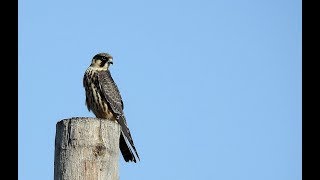


Biology
The Hobby is common, in places abundant breeding migrant. Inhabits the riparian woods and groves in steppes and deserts, the shelterbelts, the open landscapes with the singles trees; the mountain deciduous and coniferous forests surrounded the open areas; in altitudes up to 2500-2700 m in Tien Shan. In spring appears in mid - end April, on Markakol lake in early May. Migrates singly or in pairs, at Chokpak Pass the migration finishes in mid-May, but in northern areas in the end of May. Nests in separate pairs at least 300-500 m (usually 1-2 km) apart. To breeding Hobbies use the old nest of Crow or Magpie without repairing, sometimes Hobbies thrust out the owners of inhabited nest. In unique occasion one female laid the eggs on the leaves on ground without any lining. Laying of 2-6 (usually 3-4) eggs is in mid-June – July. Both parents (male has brood patches) incubate for about 28 days from the laying of first egg, but mostly female. Chicks are born in July – early August, both parents feed nestlings which fledge in August – early September. In northern Kazakhstan laying is in May – early June, chicks fledge in mid-July – early August. The later breeding in southern Kazakhstan explained by the adaptation of the chicks feeding by the migrating birds (Sparrows, Swallows) mostly. The autumn migration begins in August, the latest birds leave northern Kazakhstan in the middle of September. On Markakol lake singly Hobby was observed on October 26. In southern areas the active traffic of migration is in September – early October. Hobbies migrate singly or in loose groups of 3-5 birds.
Sources
Gavrilov E. I., Gavrilov A. E. "The Birds of Kazakhstan". Almaty, 2005. Э.И.Гаврилов. "Фауна и распространение птиц Казахстана". Алматы, 1999. В.К.Рябицев. "Птицы Урала, Приуралья и Западной Сибири". Екатеринбург. Изд-во Уральского университета, 2000.