Black-winged Stilt
Himantopus himantopus Linnaeus, 1758
Ұзынсирақ балшықшы


 1 / 3
adult Zhangala region, West-Kazakhstan oblast
juvenile Sorbulak lake, Almaty oblast
in flight Kanshengel, Taukum sands, Southern Trans-Balkhash area
- status in Kazakhstan
- nests here · on migration
- conservation status
- IUCN LCleast concern
- sizes
- 35–40 cm, wingspan 67–83 cmweight 180–220 g
- when to see it
- March — September
- on the site
- 1025 observationslast: 21 Aug 2026
- videos
- 2
Description
Немного меньше голубя (по весу и размерам тела), но очень долговязая птица с непомерно длинными красными ногами и черно-белым оперением. Черная шапочка и полоса вдоль задней стороны шеи у разных особей выражены очень по-разному, но самки выглядят более белоголовыми. Часто и самцы и самки (самки чаще) с совершенно белой головой. У самки черный цвет на спине и крыльях тусклее, бурее, у самца - чернее, с зеленым отливом. Осенью у всех птиц есть шапочка, опускающаяся до глаза и уха. Молодые до самого отлета хорошо отличаются от взрослых грязно-бурой окраской темных частей оперения, со светлым чешуйчатым рисунком, глаза желто-бурые (у взрослых - малиново-красные), ноги розовато-серые, с неровным голубым налетом. Вес 180-220 г, длина 35-40, крыло 20.6-25.5, размах 67-83 см.
Distribution
Breeds in plains of southern part of Kazakhstan in north to Kamysh-Samar lakes, Utva-Ilek interfluves, Naurzum, Petropavlovsk and Zaysan depression. In 1989 occurs on breeding in some places at area adjacent to Irtysh river in Pavlodar oblast. On migration occurs almost everywhere.
- I
- II
- III
- IV
- V
- VI
- VII
- VIII
- IX
- X
- XI
- XII
- Breeding
- Migration
- Wintering
Map © Birds.kz. Copying without permission is prohibited
Subspecies
- Black-winged Stilt Himantopus himantopus himantopus
Latest observations
all species photos · 1025 →


 4
Species videos · 2
all species videos · 2 →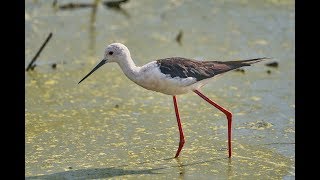

Biology
Common breeding migrant. Inhabits the fresh and salty lakes with shallow coastal water and muddy, sandy or pebbly shores. In spring arrives in mid-March in southern areas, and in early – mid-April or even in May in northern ones, flies by small flocks of 5-15 birds. Breeds in colonies of one-three dozen pairs mostly, together with terns, gulls and other waders often. Nest is located on islands, small hummocks in shallow water, or on wet shore near water. Nest is either the hole on ground lined with some dry grass, or the large construction up to 25 cm of diameter made from the dry grass stems and is lined with soft leaves in case of location the nest among the water. On increasing the water level, birds raise the height of nest to safe eggs of flooding. Clutch of 4, rare of 3 eggs (sometimes two females lay eggs to one nest) is produced from end April until mid-June. Such long breeding period depends not only on the different latitudes of breeding sites, but also by re-nesting after loss of first clutch. Both parents incubate and care for chicks, which hatch in May – July. After the juveniles begin to fly (early June - end August) the Stilts wander for some time, and then gather in flocks. Flight visually unnoticed because Stilts fly very high above the ground. From northern Stilts disappear at the end of August, from the south ones at the beginning or middle of September.
Sources
Gavrilov E. I., Gavrilov A. E. "The Birds of Kazakhstan". Almaty, 2005. Э.И.Гаврилов. "Фауна и распространение птиц Казахстана". Алматы, 1999.