
Pied Avocet
Recurvirostra avosetta Linnaeus, 1758
Бізтұмсық

 1 / 2
adult Sorbulak lake, Almaty region
juvenile Kulsary area, Zhylyoi region, Atyrau oblast
- status in Kazakhstan
- nests here · on migration
- conservation status
- IUCN LCleast concern
- when to see it
- March — October
- on the site
- 463 observationslast: 21 Aug 2026
- videos
- 2
Description
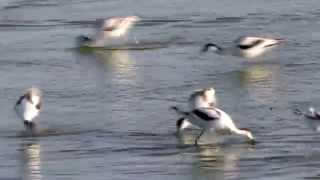
Quite a large wader. The crown, nape, outer scapulars, tertials, primaries, lesser and medium wing coverts are black often brown-tinged. The rest of plumage is white. Bill is black, thin, elastic, highly flattened, bill is straight only in the base part but in top part heavy upwards curved. Legs are blue-gray, rather long, with the well-developed membrane connecting all three fingers. Iris is brown. On juveniles the black in the plumage is replaced by brown; the scapulars and the inner secondaries are gray white-mottled and white-bordered. Size: wing 200-235 mm, tarsus 81-100 mm, bill 75-95 mm. Weight: autumn males 219-311 gr, females - 256-282 gr.
Distribution
Occasionally breeds on salty lakes to north up to Kamysh-Samarskiye lakes, Chelkar lake, lower reaches of Ilek river, Mokroye and Teniz lakes in Kustanay oblast, Petropavlovsk, Pavlodarskoye Trans-Irtysh'e and Zaysan depression. On migration occurs in plains everywhere.
- I
- II
- III
- IV
- V
- VI
- VII
- VIII
- IX
- X
- XI
- XII
- Breeding
- Migration
- Wintering
Map © Birds.kz. Copying without permission is prohibited
Latest observations
all species photos · 463 →


Species videos · 2
all species videos · 2 →
Biology
Common, in places rare breeding migrant. Inhabits the salty or rare fresh lakes with salt-marsh, sandy or pebbled shores and islands. In spring appears in the end of March – early April, but in northern areas in end of April – early May; arrives in flocks of two-three dozen birds. Breeds in colonies (mainly on islands) up to 70 pairs, often together with stilts, terns, gulls and other waders. Nest is located on the bare ground in the shallow hole usually without lining, or lined with several dry grass pieces. Clutch of 2-5 eggs is produced in the end of April – early June. Both parents incubate for 25-26 days, and care for juveniles, which hatch in May – June and begin to fly in the end of June – early August. In windy weather nests are often flooded with water therefore re-breeding is not rare. On coast of Caspian and Aral Seas and on big salty lakes in August gathers in large flocks of up to 200-500 birds. The autumn migration begins early, and passes mostly in August.
Sources
Gavrilov E. I., Gavrilov A. E. "The Birds of Kazakhstan". Almaty, 2005. Э.И.Гаврилов. "Фауна и распространение птиц Казахстана". Алматы, 1999. "Птицы Казахстана" том 2. изд. АН КазССР. Алма-Ата, 1962.