
Great Cormorant
Phalacrocorax carbo Linnaeus, 1758
Үлкен суқұзғын


 1 / 3
adult Sorbulak lake, Almaty region
juvenile Aktau, Karakol lake
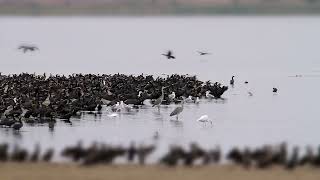
flock Bugun reservoir, South Kazakhstan oblast
- status in Kazakhstan
- nests here · on migration · winters here
- conservation status
- IUCN LCleast concern
- sizes
- 80–100 cm, wingspan 130–160 cmweight 1.7–2.8 kg
- when to see it
- March — Novemberwinters: December — February
- on the site
- 1620 observationslast: 31 Oct 2026
- videos
- 3
Description
Крупная, с гуся, водоплавающая птица с почти полностью черным оперением, клюв удлиненный, с крючком. Низ "лица" белый, в брачном наряде на голове и верхе шеи более или менее обильны узкие белые перья, выпадающие уже в период насиживания. В брачном наряде есть белое пятно на корпусе в области бедра. В осеннем оперении верх головы и шея черные, белых пятен на боках нет. От гусей и других гусеобразных, а также от гагар отличается в полете черной окраской и длинным закругленным хвостом. У плавающих птиц хвост опущен и не виден. Полет довольно легкий, со сравнительно нечастыми взмахами крыльев. Молодые бурые, брюхо светлее верха и может быть почти белым. У годовалых светлая окраска брюха сохраняется. Годовалые и более старшие, но неполовозрелые птицы не имеют белых пятен на боках. Сидящие на берегу или на кустах и деревьях бакланы часто принимают своеобразную, свойственную только им позу, когда они просушивают раскрытые крылья. Вес 1.7-2.8 кг, длина 80-100, крыло 31.1-36.4, размах 130-160 см.
Distribution
Breeding in Syrdarya valley, Balkhash-Alakol and Zaysan depressions, irregularly on Kamysh-Samar lakes, in lower reaches of Turgay river, in Naurzum Reserve and on Kurgaldzhin lakes. Between 1980-1990 a colony existed on Sorbulak lake close to Almaty, where birds also nested since 2001 to now. In recent years nesting renewed on northern Caspian Sea, near delta of Ural river. During migration and dispersal they occur everywhere, including Southern Altai (Markakol lake) and Zailiyskiy Alatau ridge. At end of October some flocks can be observed over Almaty (up to 100-150 birds) migrating in direction of Issyk-Kul lake.
- I
- II
- III
- IV
- V
- VI
- VII
- VIII
- IX
- X
- XI
- XII
- Breeding
- Migration
- Wintering
Map © Birds.kz. Copying without permission is prohibited
Subspecies
- Continental Cormorant Phalacrocorax carbo sinensis
Latest observations
all species photos · 1620 →


Species videos · 3
all species videos · 3 →

Biology
Common but locally rare breeding migrant, rare wintering species. Inhabits only fish lakes and reservoirs, sometimes salty. Arrives after opening of reservoirs, in March in southern areas, and early – mid-April in North. During migration and dispersal, flocks from 5-10 up to several hundred occur. Breeding in large colonies, sometimes numbering up to a thousand pairs, but more often smaller. Frequently nests together with Grey Heron, Spoonbill, Night Heron, Pelican, etc. Breeding begins in April. Bulky nests are built among reed-beds, on shore rocks and on stony or sandy islands, on flooded trees, or in forest-belt on small islands, from dry twigs or reed stems; inner cup lined with grass and reed leaves; nest are often very close one another. Breeding is prolonged even in one colony. Fresh eggs found from mid – end April up to mid-June. Very late nesting recorded in Ile river delta and may be connected with first time breeders which tend to nest much later than adults. Clutches of 3-5 eggs end April – mid-June. Both parents incubate 28-30 days. Young fly as early as June. Later they are united in flocks and live a nomadic life. Migration from northern half of Kazakhstan in September (last birds seen early October), from south in October – mid-November, though some birds observed in early December.
Sources
Gavrilov E. I., Gavrilov A. E. "The Birds of Kazakhstan". Almaty, 2005. Э.И.Гаврилов. "Фауна и распространение птиц Казахстана". Алматы, 1999. В.К.Рябицев. "Птицы Урала, Приуралья и Западной Сибири". Екатеринбург. Изд-во Уральского университета, 2000.