
Common Oystercatcher
IUCN Red List
NT · Near Threatened
iucn text near threatened
IUCN assessment: 2019 · iucnredlist.org
Haematopus ostralegus Linnaeus, 1758
Сауысқан балшықшы

 1 / 2
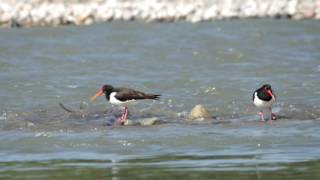
adult, summer Sorbulak. Almaty oblast.
juvenile Little Sorbulak. Almaty oblast.
- status in Kazakhstan
- nests here · on migration
- conservation status
- IUCN NTnear threatened
- sizes
- 40–46 cm, wingspan 80–86 cmweight 400–600 g
- when to see it
- March — October
- on the site
- 453 observationslast: 5 Aug 2026
- videos
- 4
Description
Крупный, с ворону, коренастый кулик с контрастным черно-белым оперением. Большой оранжевый клюв, уплощенный с боков, довольно изменчив по форме и длине. Ноги невысокие розовые трехпалые. Самцы и самки внешне не отличаются. Осенью на горле белый полуошейник, конец клюва темноватый. Молодые отличаются от взрослых бурым верхом вместо черного, со светлыми каемками на перьях, нет белого горлового пятна, клюв темный с грязно-оранжевым основанием, обычно короче, чем у взрослых и более заостренный, ноги бурые, глаза бурые (у взрослых - красные), окологлазное голое кольцо темное, почти не выраженное (у взрослых - яркое оранжево-красное). Годовалые птицы (2-е календарное лето) хорошо отличаются от более старых наличием белого полуошейника, темноватым (особенно на конце) и более заостренным клювом, глаза и окологлазное кольцо бурые или красно-бурые. Вес 400-600 г, длина 40-46, крыло 23.5-28.4, размах 80-86 см.
Distribution
Breeds in the steppe and forest-steppe zones of Kazakhstan, and also in the deserts of Southern Trans-Balkhash area, in the valleys of Syrdaria and Chu rivers, and on Mangyshlak on coast of Caspain Sea. Please see also the section Subspecies.
- I
- II
- III
- IV
- V
- VI
- VII
- VIII
- IX
- X
- XI
- XII
- Breeding
- Migration
- Wintering
Map © Birds.kz. Copying without permission is prohibited
Subspecies
- Common Oystercatcher Haematopus ostralegus longipes
- Common Oystercatcher Haematopus ostralegus buturlini
Latest observations
all species photos · 453 →


 8
Species videos · 4
all species videos · 4 →


Biology
Rare breeding migrant. Inhabits the sandy and pebbly shores and islands, saline-soil shores with rare vegetation, stony islands on the rivers and lakes. In spring arrives from the early March to end of April (or in early May in northern areas) singly, in pairs or in small groups of 3-5 birds. Intensive flight was observed near Aralsk town where the flocks of 50-70 birds were not rare. Migration finishes in mid – end May. Breeds in separate pairs not close one pair to another (from several hundred meters to 1-2 km apart). Nest is located in the shallow hole on the sandy, saline-soil, pebbly shore; hole is sometimes lined with several dry grass stems. Clutch of 2-3 (rare 4) eggs is produced from the end of April to early June. Both parents incubate for about 27 days, and care for juveniles which hatch in June and begin to fly in end June – July. Re-nesting after loss of first clutch on account of flooding was observed. The autumn migration begins in August in flocks of up to 50-70 birds, most birds disappear in September.
Sources
Gavrilov E. I., Gavrilov A. E. "The Birds of Kazakhstan". Almaty, 2005. Э.И.Гаврилов. "Фауна и распространение птиц Казахстана". Алматы, 1999.