
Eurasian Stone Curlew
Burhinus oedicnemus Linnaeus, 1758
Жылқышы

 1 / 2
adult Kyzylkumy
chicks Kyzylkum
- status in Kazakhstan
- nests here · on migration
- conservation status
- IUCN LCleast concern
- sizes
- 40–44 cm, wingspan 77–85 cmweight 350–450 g
- when to see it
- March — October
- on the site
- 110 observationslast: 19 Aug 2026
- videos
- 1
Description
Крупный кулик (крупнее голубя) с преимущественно песочной окраской верха тела и с многочисленными продольными пестринами. На крыле характерные темные и белые полосы и пятна. Большими желтыми глазами и остальной внешностью хорошо отличается от всех других видов. Ноги трехпалые. Самка слабо отличается от самца менее четкими полосами на сложенном крыле. Молодые имеют еще более тусклые полосы на крыле, более охристый верх тела, продольные пестрины менее резкие. Вес 350-450 г, длина 40-44, крыло 22,4-25,5, размах 77-85 см.
Distribution
Breeds and occurs on migration in southern part of Kazakhstan, in north to Kamysh-Samar lakes, Ilek mouth, lower reaches of Turgay river, Northern Trans-Balkhash area and Zaysan depression. In Kurgaldzhino on May 29, 1979 the breeding female laid one egg was obtained. Near Semipalatinsk observed in groups (probably broods) 24 July. Vagrant occurs in Naurzum Reserve.
- I
- II
- III
- IV
- V
- VI
- VII
- VIII
- IX
- X
- XI
- XII
- Breeding
- Migration
- Wintering
Map © Birds.kz. Copying without permission is prohibited
Subspecies
- Eurasian Stone Curlew Burhinus oedicnemus harteri
Latest observations
all species photos · 110 → 3


 4
Species videos · 1
all species videos · 1 →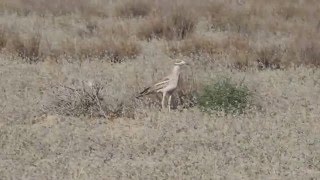
Biology
Common, in places rare breeding migrant. Inhabits the clay deserts, saline-soil lands with wormwood, saltwart and sparse saxaul or tamarisk shrubs; rare lives in sandy and stony deserts; often inhabits the lands near the water. In spring arrives in small groups at night in March or mid-April. Breeds in separate pairs. Doesn't build the nest, eggs are laid on the bare saline soil or to the shallow hole in sand. Female incubates mostly at night, but during the day time Stone Curlews leave the nest for a long time, and eggs are warmed by sun only. Male doesn’t take part in incubation but stays nearby. Clutch of 2 eggs is produced in the end of April or in early May. Chicks hatch in end May – early June, and begin to fly in July. Autumn migration begins in the end of August and finishes in mid-end September. In autumn passage the flocks up to one hundred and more birds were recorded.
Sources
Gavrilov E. I., Gavrilov A. E. "The Birds of Kazakhstan". Almaty, 2005.
Э.И.Гаврилов. "Фауна и распространение птиц Казахстана". Алматы, 1999. В.К.Рябицев. "Птицы Урала, Приуралья и Западной Сибири". Екатеринбург, Изд-во Уральского университета, 2000.
Э.И.Гаврилов. "Фауна и распространение птиц Казахстана". Алматы, 1999. В.К.Рябицев. "Птицы Урала, Приуралья и Западной Сибири". Екатеринбург, Изд-во Уральского университета, 2000.