
Common Crane
Red Book of the Republic of Kazakhstan
Category III · rare species
Grus grus Linnaeus, 1758
Сұр тырна


 1 / 3
adult Kostanay region, Fedorovskiy district, Ozernoe.
juvenile Kostanay region, Karabalyk district, Slavyanka village.
in flight Sorbulak. Almaty oblast.
- status in Kazakhstan
- nests here · on migration
- conservation status
- Red Book of Kazakhstan · III IUCN LCleast concern
- sizes
- 114–130 cm, wingspan 200–230 cm
- when to see it
- February — October
- on the site
- 357 observationslast: 8 Oct 2026
- videos
- 1
Description
Окраска преимущественно серая, чем хорошо отличается от стерха и аистов. Несмотря на разницу в размерах, легко спутать с журавлем-красавкой. В отличие от него, нет украшающих перьев за глазом и на затылке, но примерно в том же месте есть белое пятно, спускающееся на шею. Низ шеи серый, без свисающих черных перьев. Красную голую кожу на темени издалека разглядеть, как правило, не удается. У серого журавля голова более удлиненная, чем у красавки. Оперение молодых птиц рыжевато-серое, в том числе и на голове и шее, к первой весне приобретают окраску почти как у взрослых. Вес взрослых птиц 3.0–6.1 кг, длина 114–130, крыло 54.0–66.0, размах 200–230 см.
Distribution
Irregularly breeds in almost all regions of Kazakhstan, on migrations occurs everywhere except Mangyshlak. Please see detailed distribution in the section Subspecies.
- I
- II
- III
- IV
- V
- VI
- VII
- VIII
- IX
- X
- XI
- XII
- Breeding
- Migration
- Wintering
Map © Birds.kz. Copying without permission is prohibited
Subspecies
- Common Crane Grus grus grus
- Common Crane Grus grus lilfordi
- Tibetan Common Crane Grus grus korelovi
Latest observations
all species photos · 357 →


 4
Species videos · 1
all species videos · 1 →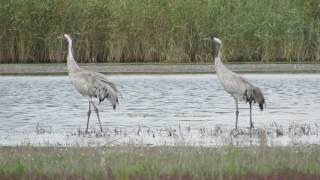
Biology
Rare breeding migrant, more common during spring and autumn migrations. Inhabits the reed-beds of lakes, wet meadows, hummock marshes among birch groves both on plains and in mountains at altitudes up to 2000 m in Altai and 1950 m in Tien Shan (Tuzkol lake). In spring appears in the end of February - early March to April. Migrates both by day and by night in flocks of 30-40 to one hundred birds, or rare in groups of 3-10 birds. Latest spring migrants observed in end of May. Breeds in separate pairs, at distance several kilometers one from another. Nest is located on patch of dry land among the water, or on shallow water among the reed-bed near the dry shore; nest is built from reed and grass stems, and is lined with grass. Clutch of 2-3 eggs is laid in April – May. Mostly female incubates clutch for about one month, male standing guard nearby. Chicks hatch in May – June and begin to fly in mid July – August. In end of May – June non-breeding Cranes gather in thousands to wing moulting on vast shallow salt lakes (Selety-Teniz, for example), where they rest on island or in shallow water and feed in nearby steppe. Autumn migration begins in August, most birds fly off in mid-September – early October, odd birds linger until end of November.
Sources
Gavrilov E. I., Gavrilov A. E. "The Birds of Kazakhstan". Almaty, 2005. Э.И.Гаврилов. "Фауна и распространение птиц Казахстана". Алматы, 1999. В.К.Рябицев. "Птицы Урала, Приуралья и Западной Сибири". Екатеринбург. Изд-во Уральского университета, 2000. В.Ю.Ильяшенко, О.В.Белялов "Новый подвид серого журавля Grus grus korelovi ssp. из Центрального и Восточного Тянь-Шаня."