
Greater Flamingo
Red Book of the Republic of Kazakhstan
Category II · declining species
Phoenicopterus roseus Pallas, 1811
Қоқиқаз

adult and juvenile Zhumai settlement, Korgalzhyn region, Akmola oblast
- status in Kazakhstan
- nests here · on migration · winters here
- conservation status
- Red Book of Kazakhstan · II IUCN LCleast concern
- sizes
- 125–145 cm, wingspan 140–160 cmweight 2–4 kg
- when to see it
- March — Novemberwinters: December — February
- on the site
- 291 observationslast: 11 Oct 2026
- videos
- 1
Description
Очень длинноногая и длинношейная крупная птица с большим (не длинным), коленообразно изогнутым книзу клювом. Все оперение розовое, кроющие перья крыла красные, маховые - черные. Самец и самка окрашены сходно, самец несколько крупнее. Молодые грязно-белые, сверху - буроватые. Вес 2-4 кг, длина 125-145, крыло 31.0-35.4, размах 140-160 см.
Distribution
Irregularly breeds in Central Kazakhstan (Zhamanakkol, Chelkar-Teniz, Aschitastysor, Tengiz lakes), and also on Caspian Sea on Mertvy Kultuk gulf. On dispersal and migration it occurs very widely in plains, occasionally in foothills of Western Tien Shan (20 October 1973, 9 birds).
- I
- II
- III
- IV
- V
- VI
- VII
- VIII
- IX
- X
- XI
- XII
- Breeding
- Migration
- Wintering
Map © Birds.kz. Copying without permission is prohibited
Latest observations
all species photos · 291 → 2

 6

Species videos · 1
all species videos · 1 →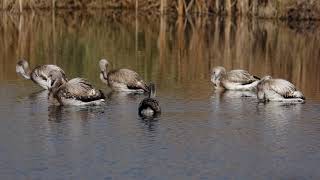
Biology
Rare breeding migrant. Nests on the very salty and shallow lakes where there is the Brine Shrimp (Artemia salina) which is the basic food for the Flamingos. In spring appears in the end of March – late April in small groups or in flocks of 100-600 birds. Migration ends in mid-end May with arriving of immature birds. Breeds in colonies from 50 to 30 000 pairs. Cone-shaped nests 7-60 cm in height are constructed from the mud which is surrounded the colony and which is consist of salty silt, sand and seaweed, but sometimes eggs are laid directly on sand even without nest hollow. Clutch of 2-3, rarer 1 egg, is produced in early May to end of June. Juveniles begin to fly in August – early September. Autumn migration passes in September – October. Odd birds linger until the freezing of reservoirs. Birds breeding in Kazakhstan (Tengiz lake) and in Iran (Urmia lake) are formed the one population; the juveniles ringed in Iran in next years were regularly observed on moulting on Tengiz lake.
Sources
Gavrilov E. I., Gavrilov A. E. "The Birds of Kazakhstan". Almaty, 2005. Э.И.Гаврилов. "Фауна и распространение птиц Казахстана". Алматы, 1999. В.К.Рябицев. "Птицы Урала, Приуралья и Западной Сибири". Екатеринбург. Изд-во Уральского университета, 2000.