Yellow Wagtail
Motacilla flava Linnaeus, 1758
Сары наурызек


 1 / 3
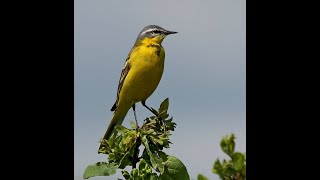
male Zelenovsky region, West Kazakhstan oblast
female Korgalzhyn Reserve, Karazhar
1st winter Sorbulak, Almaty region
- status in Kazakhstan
- nests here · on migration
- conservation status
- IUCN LCleast concern
- sizes
- 17 cm, wingspan 23–27 cmweight 14–24 g
- when to see it
- April — September
- on the site
- 1249 observationslast: 21 Aug 2026
- videos
- 7
Description
The Yellow Wagtail is slightly less than White Wagtail with shorter tail. The male in breeding plumage has brightly-yellow underparts and greenish-yellow upperparts. The color and pattern of the head are very variable on different subspecies from all-white to dark-grey (please see the "Races" chapter). The flight feathers and wing coverts are dark-brown with pale edges of the outer webs. On the last secondaries and greater coverts these edges are broad pale-yellow. Two outer pairs of the tail feather are white with black patches on the inner webs, all other tail feather are black with narrow yellowish edges. The bill and legs are black, eyes are brown. The female in breeding plumage is plain grayish-brown above sometimes with green tinge expressed to uppertail having yellowish-green color. The underparts are white or pale-yellow; from the chin to undertail the color changes from almost white to brightly-yellow. After autumn plumage adult birds have grayish-olive tone; the head and mantle are same color; the ear coverts are not darker than other head parts. Underparts are yellow or yellowish-white. Juveniles are dirty buff-brownish above with buffy-whitish edges of wing coverts. Underparts are buffy, flanks are brownish. The throat and craw are dark mottled; legs are brownish. Juveniles are distinguished from juveniles of White Wagtail by the domination of the brown and rusty tones; by the expressive pale supercilium including between the eye and bill. In August juveniles become similar on autumn females and have some yellow on the abdomen. 14-24 grams, length about 17, wing 7,4-8,7, wingspan 23-27 cm.
Distribution
The Yellow Wagtail breeds in the northern half of Kazakhstan, on migration occurs throughout. The detailed distribution in Kazakhstan please see in the chapter "Races".
- I
- II
- III
- IV
- V
- VI
- VII
- VIII
- IX
- X
- XI
- XII
- Breeding
- Migration
- Wintering
Map © Birds.kz. Copying without permission is prohibited
Subspecies
- Yellow Wagtail Motacilla flava beema
- Grey-headed Wagtail Motacilla flava thunbergi
- Yellow Wagtail Motacilla flava flava
- Yellow Wagtail Motacilla flava zaissanensis
- North Mongolian Yellow Wagtail Motacilla flava leucocephala
- Hybrid Wagtail Motacilla (flava x feldegg)
- Hybrid Wagtail Motacilla (flava x lutea)
Latest observations
all species photos · 1249 →
 2
 4
 2
Species videos · 7
all species videos · 7 →


Biology
The Yellow Wagtail is abundant breeding migrant. Inhabits the wet meadows with tall grass and scattered bushes or reed edges; wet shores of the lakes and flood plains up to foothills at 400-450 m. During migration visits the desert plains near water sources; reed beds (where thousands birds concentrate); and rare the highlands up to 3200 m. Appears after the snow-break in flocks of 30-150 birds on mid March to early April in southern areas, and mid–end April in northern ones. Most birds migrate mid April to early May; last spring migrants recorded on mid-end May. Breeds in loose colonies, nests set not far from each other. To the Yellow Wagtail's the non-uniform distribution is specific. The same habitat is not occupied, but in some places the dense settlements form, where the pairs set in tens meters one from another. Nest is built in recession on the ground under the grass shelter; from the dry grass; and lined with hair and some feathers. Clutches of 4-6 eggs appears mid May to mid June. Mostly female incubates for 12-13 days. Both parents feed juveniles fledged at 14-15 days old, mid June – mid July. Replaced breeding after the losing of the first nest is common. From the mid-summer the broods and mixed flocks of adults and juveniles wander on near water countries. Autumn migration begins late July to early August, most birds migrate end August to mid September; last autumn migrants recorded early – end October or even early November.
Sources
Gavrilov E. I., Gavrilov A. E. "The Birds of Kazakhstan". Almaty, 2005.
"Птицы Казахстана" том 3. "Наука". Алма-Ата, 1970.
В.К.Рябицев. "Птицы Урала, Приуралья и Западной Сибири". Екатеринбург, Изд-во Уральского университета, 2000.
Э.И.Гаврилов. "Фауна и распространение птиц Казахстана". Алматы, 1999.
"Птицы Казахстана" том 3. "Наука". Алма-Ата, 1970.
В.К.Рябицев. "Птицы Урала, Приуралья и Западной Сибири". Екатеринбург, Изд-во Уральского университета, 2000.
Э.И.Гаврилов. "Фауна и распространение птиц Казахстана". Алматы, 1999.