
Barn Swallow
Hirundo rustica Linnaeus, 1758
Қыстау қарлығашы


 1 / 3
adult Sasyk well, Malay-Sary ridge, Almaty region.
juvenile Kyzylasker, Sary-Agash region, South Kazakhstan oblast
nest Bakbakty, Balkhash region, Almaty oblast
- status in Kazakhstan
- nests here · on migration
- conservation status
- IUCN LCleast concern
- sizes
- 17–23 cm, wingspan 32–34.5 cmweight 16–22 g
- when to see it
- April — October
- on the site
- 968 observationslast: 8 Oct 2026
- videos
- 3
Description
The Barn Swallow is a little bird with long body, long deep-forked tail, long with pointed tip wings, short and broad bill and short and slack legs. The adult male has steel blue upperparts and a rufous forehead, chin and throat, which are separated from the off-white (or rusty on some subspecies) underparts by a broad dark blue breast band. The outer tail feathers are elongated, giving the distinctive deeply-forked "swallow tail." There is a line of white spots across the outer end of the upper tail. The female is similar in appearance to the male, but the tail streamers are shorter, the blue of the upperparts and breast band is less glossy, and the underparts more pale. The juvenile is browner and has a paler rufous face and whiter underparts. It also lacks the long tail streamers of the adult. Length 17–23 cm including 2–7 cm of elongated outer tail feathers. It has a wingspan of 32–34.5 cm and weighs 16–22 grams.
Distribution
The Barn Swallow in Kazakhstan nests near the human settlements in all countries excluding mountains and deserts. On migration occurs throughout. The detailed distribution in Kazakhstan please see in the chapter "Subspecies".
- I
- II
- III
- IV
- V
- VI
- VII
- VIII
- IX
- X
- XI
- XII
- Breeding
- Migration
- Wintering
Map © Birds.kz. Copying without permission is prohibited
Subspecies
- Barn Swallow Hirundo rustica rustica
- Barn Swallow Hirundo rustica tytleri
- Barn Swallow Hirundo rustica gutturalis
Latest observations
all species photos · 968 →
 2


Species videos · 3
all species videos · 3 →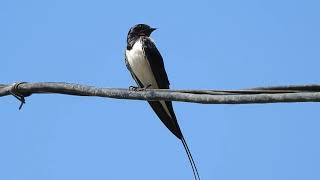


Biology
The Barn Swallow is common, sometimes abundant, breeding migrant. It inhabits localities (farms and villages), both on plains and in mountains up to 1800-2000 m in Tien Shan and 1500 m in Altai; often near the water. During migration it occurs in steppes, deserts, meadows, and near rivers and lakes especially with adjoining reed-beds, where they roost in huge numbers. It appears in small flocks of 20 - 50 birds in the end March – early April in southern areas, and in the mid April – early May in mountains and northern parts of the range. At Chokpak Pass last spring migrants recorded in the end May – early June. The Barn Swallow breeds by single pairs and in loose colonies of several dozen pairs. Nest is built under the roofs of houses, verandas, attics, sheep-folds, and cow-sheds; under the bridges, on the walls and on other suitable vertical surfaces. It is constructed from the mud balls mixed with some grass and hair and is lined with the thin grass, hairs and feathers. Both partners build nest for 4-10 days. Clutches of 3-8 (more often of 4-6) eggs found at end April – mid August. Only female incubates for 12-18 days. Both parents feed juveniles, which fledge at 20-22 days, in mid June – early September. Exceptionally late broods fed by parents have been recorded on 2 October 1962 and 6 October 1948. Two broods are reared per season and repeated breeding after losing of the first nest is common. It fed mostly by flying insects, sometimes by spiders caught on the walls or in grass. Autumn migration starts in mid August. Majority of birds migrate in mid September - early October, in mixed flocks with Pale Sand Martin, Sand Martin, Red-rumped Swallow and House Martin. At Chokpak Pass, a huge flock of about 300-400 thousands birds was observed on 1 October 1967 between 2pm and 5pm. Last autumn migrants recorded on mid – late October. In south-eastern Kazakhstan the cases of mass death of Barn Swallows has been noted in spring and autumn, after the spells of heavy rain, snow and frost.
Sources
В.К.Рябицев. "Птицы Урала, Приуралья и Западной Сибири". Екатеринбург, Изд-во Уральского университета, 2000.
Gavrilov E. I., Gavrilov A. E. "The Birds of Kazakhstan". Almaty, 2005.
Э.И.Гаврилов. "Фауна и распространение птиц Казахстана". Алматы, 1999.
Gavrilov E. I., Gavrilov A. E. "The Birds of Kazakhstan". Almaty, 2005.
Э.И.Гаврилов. "Фауна и распространение птиц Казахстана". Алматы, 1999.